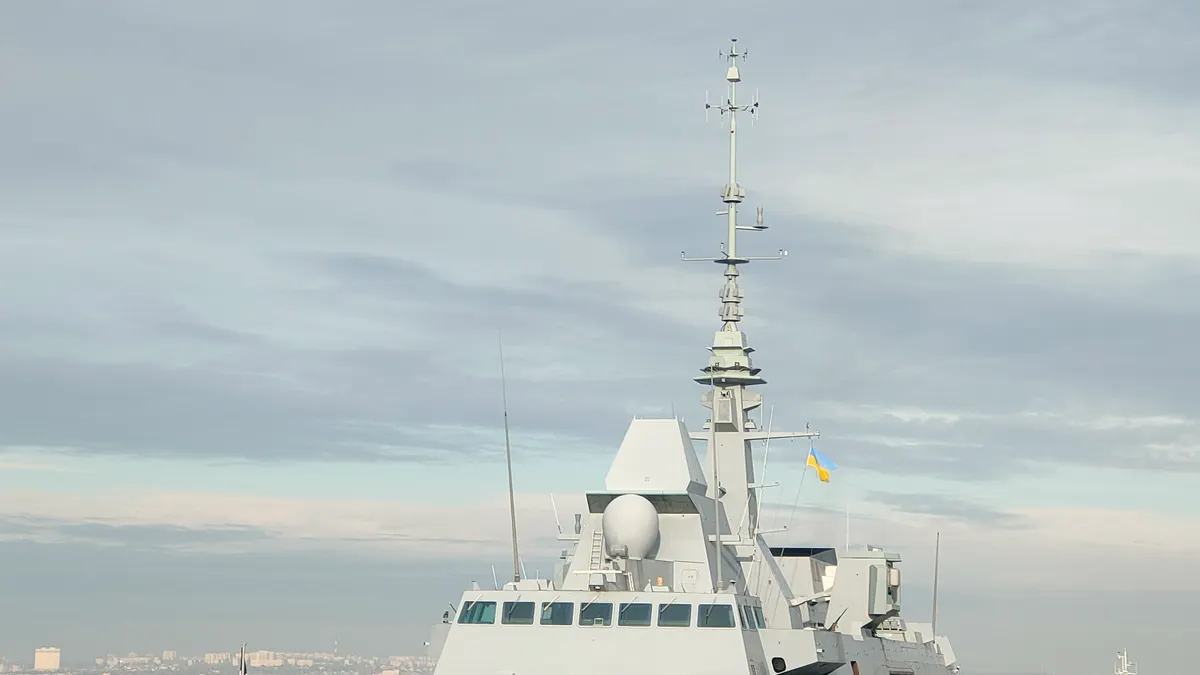
Ashank is an Anti-Submarine Warfare Shallow Water Craft (ASW-SWC) built by Garden Reach Shipbuilders and Engineers (GRSE) for the Indian Navy. The ship, identified as Yard 3036, was delivered on 23 November 2026 at Visakhapatnam. It belongs to a specialised class designed to strengthen underwater surveillance and anti-submarine operations in coastal waters. These ships are smaller and more manoeuvrable than major fleet combatants and are intended to operate where shallow water, coastal geography and local maritime traffic create distinctive challenges.
What is an ASW Shallow Water Craft?
An ASW-SWC is a naval platform designed primarily to detect and counter submarines in coastal and shallow-water environments. Such waters can be acoustically complicated because of seabed reflections, temperature layers, shipping, fishing activity and changing water depth. A specialised craft can patrol coastal approaches, support underwater surveillance and work with aircraft or larger warships as part of a wider maritime picture.
Ashank’s construction and indigenous content
GRSE designed and built Ashank in Kolkata. The Ministry of Defence said the ship was constructed in accordance with the classification rules of the Indian Register of Shipping and had more than 80 per cent indigenous content. The programme is part of India’s wider effort to strengthen domestic warship design, construction and integration of sensors and weapons. Indigenous content figures should be understood as programme-reported measures; they do not mean that every component is necessarily made in India.
Sensors and underwater surveillance
ASW-SWC platforms use sonar to detect and classify underwater contacts. Hull-mounted sonar provides a sensor integrated into the ship, while some designs also use variable-depth sonar that can be lowered into the water column to improve performance in selected acoustic conditions. Sonar operators must distinguish possible submarine signatures from environmental noise and other contacts. Detection is therefore a process involving analysis, classification and tracking rather than a simple automatic identification.
Weapons and defensive equipment
The Ministry of Defence says Ashank is equipped with lightweight torpedoes, indigenous rocket launchers and advanced sonar systems. The broader GRSE ASW-SWC design family is described as carrying torpedo tubes, rocket launchers, anti-torpedo defence, close-in weapons and other sensors. The exact fit of an individual ship should be taken from its official specifications and not assumed to be identical across every vessel in the series.
Waterjet propulsion and shallow-water manoeuvrability
The class is notable for waterjet propulsion. Waterjets can provide useful manoeuvrability and reduce the vulnerability of exposed propellers in some shallow-water settings. The GRSE design lists three marine diesel engines connected to three waterjets. Publicly listed principal particulars for the class include a length of approximately 77.6 metres, a beam of 10.5 metres and a full-load displacement of about 900 tonnes. These are class-level published specifications and should not be treated as a substitute for the ship’s final official data sheet.
How the craft fits into the Navy’s ASW network
Ashank is not intended to conduct every aspect of submarine warfare alone. Its value comes from operating alongside maritime patrol aircraft, ASW helicopters, other ships, shore-based surveillance and the Navy’s wider command network. The ship can help monitor coastal approaches, support low-intensity maritime operations and contribute to mine-laying or other secondary tasks described for the class. The combination of sensors, weapons and cooperation with aircraft is more important than any single system in isolation.
Why coastal ASW matters
Ports, naval bases, offshore infrastructure and shipping lanes can be exposed to underwater threats. Coastal geography may offer concealment to submarines and create complex acoustic conditions for defenders. A dedicated shallow-water craft allows the Navy to allocate specialised platforms to this environment while larger ships focus on broader fleet tasks. The mission also depends on trained sonar operators, maintenance, communications and sustained availability.
Related Indian Navy programmes
Ashank is part of a broader effort to induct ASW shallow-water craft built by Indian shipyards. INS Arnala, built by GRSE, was the first of the series to be commissioned in 2025. INS Mangrol, built by Cochin Shipyard Limited, represents another branch of the programme. Read our reports on Ashank’s delivery and INS Mangrol.