
TAIPEI, TAIWAN — The Taiwan Strait is witnessing another dangerous spike in military friction as Beijing intensifies its grey-zone warfare tactics. Taiwan’s Ministry of National Defense (MND) has confirmed a significant surge in Chinese military assets operating in close proximity to the self-governed island, keeping Taipei’s defense forces on high alert.
PLA Probes Taiwan’s Air Defenses; Crosses Median Line
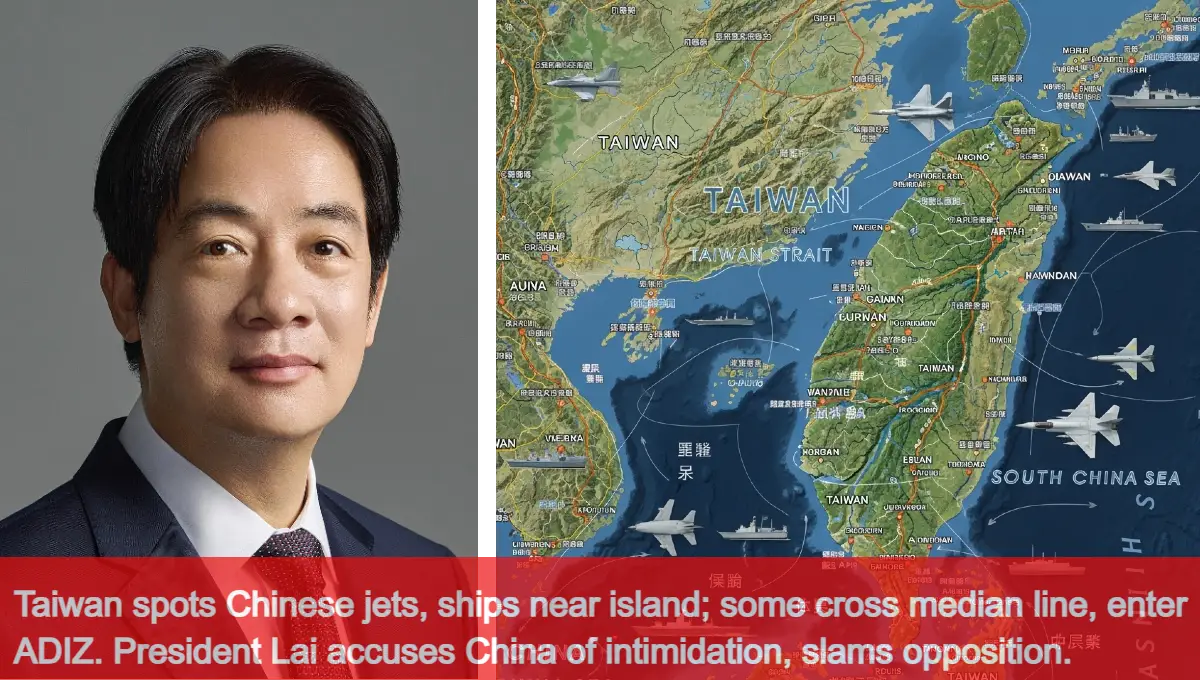
According to official defense metrics, Taipei detected 11 Chinese military aircraft, seven People’s Liberation Army Navy (PLAN) vessels, and one official state ship operating around the island.
The escalatory nature of the deployment was evident in the flight paths: 9 out of the 11 detected aircraft breached the Median Line of the Taiwan Strait—the historical, albeit unofficial, buffer zone separating the two sides. The warplanes subsequently penetrated Taiwan’s southwestern and eastern Air Defense Identification Zone (ADIZ), effectively testing the response times and readiness of the Taiwanese military.
In a swift counter-mobilization, Taiwan’s armed forces scrambled combat air patrols, deployed naval monitoring vessels, and activated coastal anti-ship and surface-to-air missile systems to track, deter, and respond to the intruding PLA assets.
Also Read: ‘China Is Angry’: Taiwan Anxiety Rises as Sabre-Rattling Grows
President Lai Exposes Beijing’s ‘Influence Warfare’
These aggressive maneuvers coincide with a stern briefing from Taiwanese President Lai Ching-te, who called out Beijing’s overarching multi-pronged strategy. Speaking during a key address, President Lai emphasized that China is seamlessly blending “influence warfare” with raw military intimidation.
He noted that this is part of Beijing’s broader blueprint for the “great rejuvenation of the Chinese nation”—a political euphemism he clearly identifies as a cover for the forced annexation of Taiwan and expanded hegemony across the Western Pacific.
Also Read: China Warns ‘foreign military intervention’ in reunification-by-force
President Lai underscored a sobering reality for Taipei’s strategic planners: this existential threat from the Chinese Communist Party (CCP) will remain constant, irrespective of shifts in Taiwan’s governmental leadership.
A Two-Front Battle: Domestic Friction Meets External Threats
Beyond the immediate kinetic threats at sea and in the air, President Lai addressed a growing internal front during the Democratic Progressive Party’s (DPP) national congress. He flagged a critical domestic challenge stemming from an opposition-controlled legislature, accusing it of bypassing established protocols, passing unconstitutional bills, and trying to cripple vital state operations via severe budget cuts.
Under the rally cry “Better Democracy, Better Taiwan,” the administration is urging the public to unite in safeguarding the island’s sovereignty against threats both internal and external.
Also Read: Chinese Warplane Enters Taiwan’s Air Defence Zone: Report
Drawing parallels to historic civil actions like the 1990 Wild Lily protests and the 2014 Sunflower Movement—where citizens successfully pushed back against overtly pro-China policies—Lai highlighted that Taiwan’s greatest defense asset is the democratic resilience of its people in protecting their hard-earned sovereignty.
(With inputs from strategic aerospace and defense agencies, a developing story)
Hawk Eye View: As Beijing consistently normalizes its presence past the Median Line, do you think the international community is doing enough to deter rising tensions in the Taiwan Strait? Let us know in the comments below.