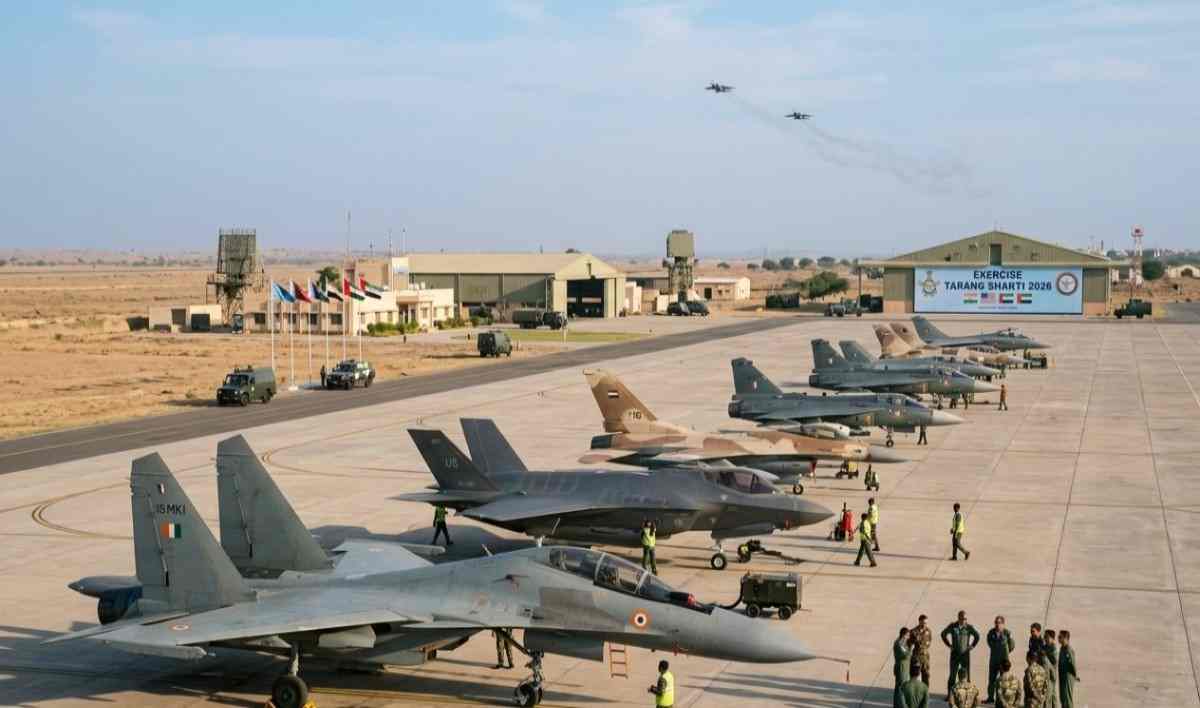


File Image Sukhoi Su-30 Via: Wikipedia
The ongoing military standoff in eastern Ladakh has pulled back the curtain on the People’s Liberation Army’s (PLA) operational playbook. To the untrained eye, China’s massive forward deployment looks like an overwhelming show of force. However, as The Indian Hawk continuously tracks across the line of control, top Indian Air Force (IAF) tacticians view it through a different lens: a rigid reliance on Cold War-era Soviet doctrine that might just be its undoing.
A senior IAF officer, speaking to Hindustan Times, pointed out that the current PLA buildup “is indicative of the Russian influence not only on Chinese military equipment but also in war planning and execution.”
The Soviet Trap: Depth vs. Vulnerability
The officer revealed on the condition of anonymity that deploying at least 50,000 troops in forward positions, backed by heavy weaponry and dense surface-to-air missile (SAM) umbrellas, mirrors classic Soviet war tactics: “This is the old Soviet way of fighting a war, with troops based in-depth areas (in this case, Hotan airbase 320km from the Line of Actual Control) providing the air-defence cover.”
But what looks like a secure rear guard actually creates a massive geographic bottleneck. High-altitude operations restrict PLA aircraft payload capacities, leaving their forward SAM sites exposed to India’s long-range, stand-off air-to-ground missiles.
Once air defenses are compromised, the dynamic shifts rapidly: “The amassed artillery, rockets and troop concentrations become exposed on the Tibetan desert, where there is no natural camouflage cover for these systems.” This matches a critical lesson from the 1999 Kargil War, where the Indian military proved that concentrated, exposed aggressors are highly vulnerable to air interdiction.
The IAF Counter-Strategy: ‘Disperse, Absorb, Recoup, Retaliate’
In response to static concentrations, India relies on a fluid operational doctrine: “Disperse, Absorb, Recoup, and Retaliate.” This was extensively verified during the 13-day exercise Gagan Shakti, where the IAF flew over 11,000 sorties, simulating a high-intensity conflict scenario.
Major General (retired) GD Bakshi noted in an Indian Express column that the drills anticipated a two-front threat: “To avoid the Chinese missile saturation attacks on known airfields, the IAF deliberately operated from scattered satellite airfields and ALGs.” The maneuvers included casualty evacuation drills under nuclear contingencies, while SU-30 MKIs carrying BrahMos cruise missiles simulated strikes over the Malacca Straits to pressure Chinese maritime assets.
The 10-Day Reality Check
On the ground, Indian security forces have secured vital tactical high ground, including the Black Top. Today, Indian and PLA troops sit eyeball-to-eyeball, separated by just a few hundred meters at specific friction points.
Should hostilities break out, planners anticipate an intense, short-duration conflict rather than a prolonged war of attrition. The IAF officer concluded that Indian forces are fully prepared to absorb and break a Chinese offensive within a high-octane 10-day window: “Any India-China hostility is unlikely to continue at an intense level without global intervention beyond 10 days.”
Analysis by The Indian Hawk
Source: Eurasian Times